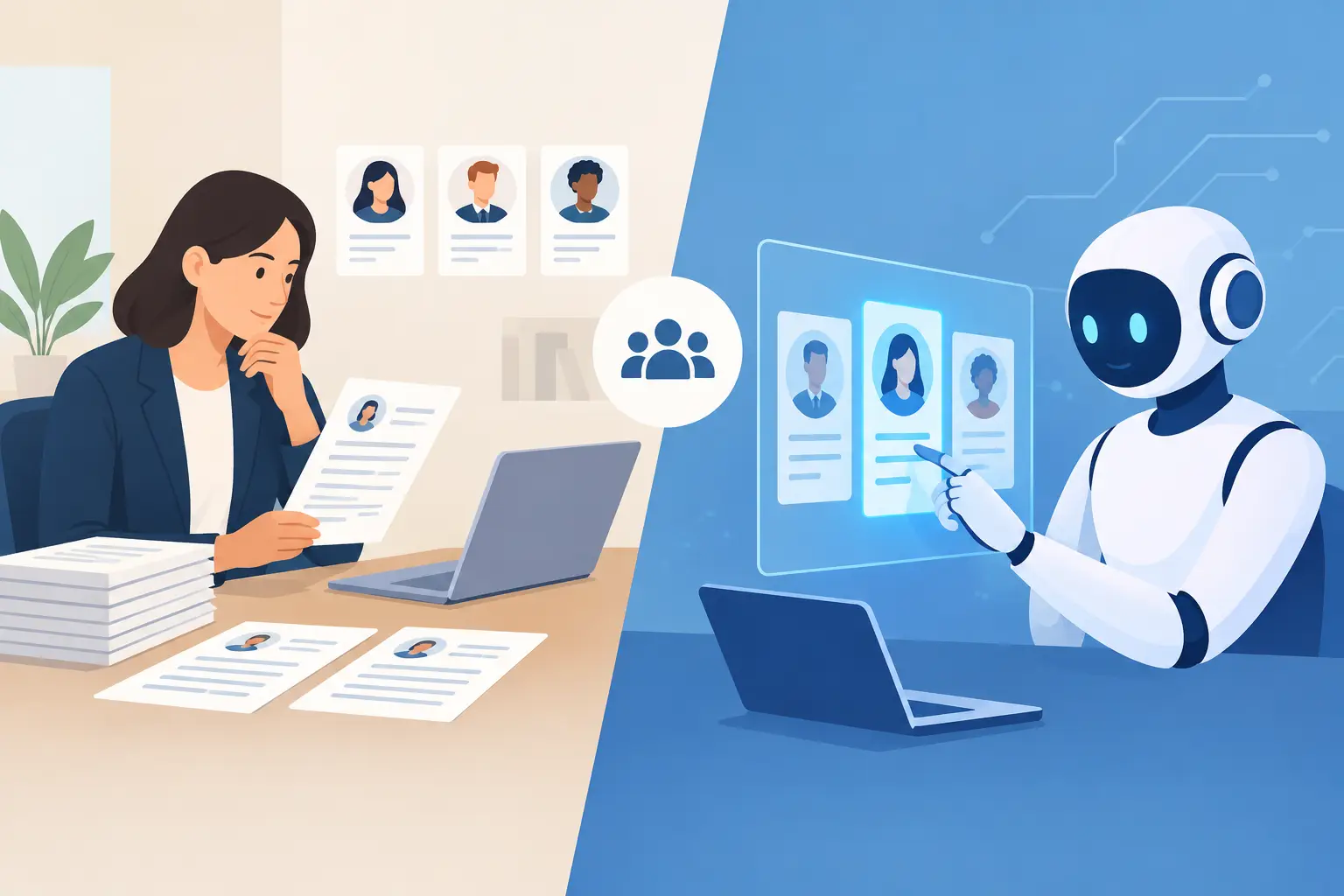
The problem with reviewing several hundred resumes manually is giving every candidate the same careful read before building your shortlist.
That is where manual screening versus AI becomes a practical operating question, not a philosophical one. Recruiters need speed. Hiring teams need defensible reasoning. Candidates deserve to be evaluated against the job rather than the luck of being reviewed early, late, or by a different person.
The strongest approach is not automation without oversight. It is a workflow where AI handles repetitive first-pass analysis and people retain authority over the decision.
Manual Screening Versus AI Is a Workflow Decision
Manual review has real strengths. Experienced recruiters notice context that a resume does not state cleanly. They can assess an unusual career path, recognize relevant adjacent experience, and ask whether a candidate’s background fits the actual team and business need. They also know when a hiring manager’s stated requirements conflict with what will make someone effective in the role.
But manual screening breaks down under volume. Reviewers get tired. Standards drift. The candidate at the top of the stack may get a deeper read than the candidate reviewed two hours later.
Those are not character flaws. They are predictable limits of a high-volume, cognitively demanding, time-constrained process.
AI can reduce those limits when it is used for the work machines do well: extracting evidence, comparing that evidence to defined criteria, applying the same framework across a large pool, and producing a clear record of why a candidate received a score. It should not be treated as the final judge of a person’s potential.
The decision is yours. The first pass does not have to be.
Where Manual Screening Still Wins
AI does not replace recruiter judgment because hiring is not a simple matching exercise. A resume is an incomplete account of a person’s work. It rarely captures leadership style, motivation, communication in the room, or whether a candidate can solve the specific problem behind an open requisition.
Manual review is especially valuable when the role is new, the criteria are still being refined, or the hiring manager is open to candidates from nontraditional backgrounds. It is also essential when a profile requires interpretation. A candidate may have changed industries but performed the same core function. Another may hold an impressive title while lacking evidence of the work that matters.
Recruiters add value by challenging assumptions. Is this requirement truly necessary? Is the team over-indexing on a familiar employer list? Did the job posting attract people with the experience the business actually needs? Software can surface patterns. People decide what those patterns mean.
The mistake is assuming that manual screening means more thoughtful screening by default. At scale, it often means less time per candidate, less consistency, and weaker documentation of why decisions were made.
Where AI Creates Immediate Leverage
The right AI screening system does more than find keywords. Keyword matching rewards resumes written to mirror a job description. It can miss candidates who used different language to describe relevant work, and it can overvalue candidates who know how to optimize a resume without proving they delivered results.
A better system evaluates evidence. What did the candidate do? In what environment? At what scope? What results, tools, responsibilities, or progression support the requirement? Then it explains the assessment in language a recruiter can review and challenge.
This matters most in the first-pass workflow. Instead of spending hours sorting documents into rough piles, a recruiter can define the standards for the role, process the applicant pool, and begin with an organized view of who appears strongest, who may be viable with questions, and who lacks critical evidence.
That creates four operational gains:
- Speed: Large resume batches can be reviewed far faster than one document at a time.
- Consistency: Every applicant is evaluated against the same employer-defined criteria.
- Explainability: Scores are tied to supporting evidence and gaps, not an unexplained black box.
- Interview readiness: Recruiters and hiring managers receive targeted questions before the first conversation.
Speed is useful. Speed with reasoning is useful enough to change how a team hires.
The Quality of AI Depends on the Criteria
AI is only as useful as the standards it is asked to apply. If a team copies an inflated job description into a screening tool, it may get a polished version of the same bad filter. If it defines what success actually requires, the results become more meaningful.
Start with the difference between must-haves and preferences. A must-have is a capability the person needs to perform the work. A preference may be a particular employer, industry, credential, or title that feels familiar but is not essential. Treating both categories as hard gates shrinks the pool and can obscure strong candidates.
Next, define the evidence that would demonstrate each requirement. For a sales leader, that may include team size, revenue ownership, sales motion, and measurable outcomes. For a technical role, it may include systems owned, production scale, architecture decisions, and the depth of hands-on work. For an operations hire, it may include process design, throughput, cost reduction, vendor management, or implementation results.
This is where JAN is designed to be useful. Teams define their standards, then receive A-D rankings supported by detailed explanations of the evidence, missing information, and areas requiring validation. It is decision-support infrastructure, not an autonomous hiring system.
When criteria change, update them. Hiring teams learn as a search progresses. A screening workflow should be able to reflect that learning without forcing the team to start over manually.
Use AI to Prepare Better Interviews, Not Skip Them
The interview is where resume claims become evidence. AI can make that conversation sharper by identifying what needs confirmation.
A candidate may state that they “led” an implementation. Did they manage the project plan, own technical delivery, influence stakeholders, or supervise the people doing the work? A resume may list a metric without explaining the candidate’s direct contribution. A targeted interview question can separate proximity from ownership.
This is a better use of AI than pretending the resume contains every answer. Strong screening output should point interviewers toward qualifications to explore, gaps to clarify, and claims that deserve a direct question.
It also improves the candidate experience. Prepared interviewers ask relevant questions. They do not spend the first 15 minutes re-reading a resume or asking applicants to repeat information already provided. Candidates notice the difference.
Controls Matter More Than Claims
Hiring teams should ask hard questions about any AI used in recruiting. Can users see why a candidate was ranked? Can they revise the criteria? Does the system allow human review before action is taken? How is applicant information handled? Is data encrypted, retained only as needed, and kept out of model training?
A responsible workflow also prevents users from adding protected-class criteria to the evaluation framework. The point is not to make broad promises about software. The point is to put useful controls around a process with real human consequences.
Blind screening can add another layer of discipline by focusing early review on relevant experience rather than identifying details. But no control removes the need for accountable people. Recruiters and hiring managers still need to review evidence, test assumptions, and make the final call.
What the Best Combined Workflow Looks Like
The practical model is simple. Upload resumes, whether they arrive as individual files, bulk batches, combined PDFs, Word documents, or through an applicant tracking system. Define the role-specific criteria. Screen for evidence. Review the explanations behind the rankings. Prepare targeted interview questions. Then interview and decide.
That sequence preserves the parts of recruiting that require human discernment while removing the repetitive work that drains recruiter capacity. It also gives leaders a more consistent view across teams and a clearer record of how the initial screen was performed.
Manual screening versus AI is not a contest to see which side wins. Manual-only processes struggle when volume rises. AI-only processes fail when context, judgment, and accountability matter. The better question is where each belongs.
Let AI organize the evidence. Let recruiters interrogate it. Then give every serious candidate the attention a high-stakes hiring decision deserves.