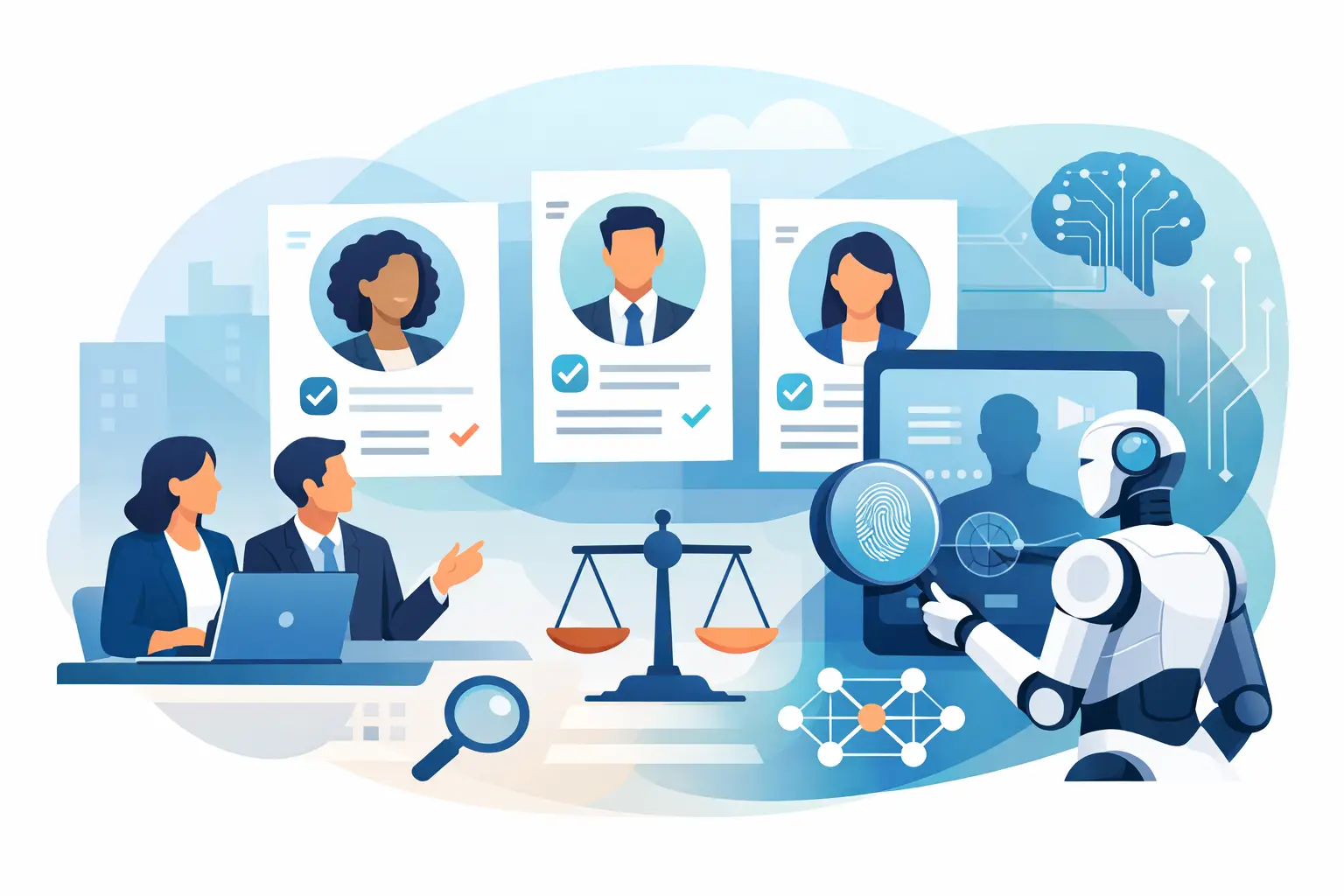
A screening tool can review 5,000 resumes before lunch. That does not make the resulting workflow defensible. An EEOC compliant AI hiring guide starts with a harder question: can your team explain why a candidate moved forward, why another did not, and who made the final call?
For recruiters managing high applicant volume, AI can reduce repetitive review and create more consistent first-pass evaluations. But speed is only useful when it is tied to job-related standards, evidence, and human judgment. The decision is yours. Your process needs to prove it.
What EEOC compliance means for AI hiring
The EEOC does not certify an AI recruiting platform as "EEOC compliant." Compliance comes from how an employer or agency designs, uses, monitors, and documents its hiring process.
That process must align with federal equal employment opportunity laws, including Title VII of the Civil Rights Act, the Americans with Disabilities Act, and the Age Discrimination in Employment Act. AI does not remove those obligations. It can introduce new risk if a tool applies criteria unevenly, relies on proxies for protected traits, screens out qualified people with disabilities, or produces a disparate impact that the employer cannot justify.
Disparate treatment is the obvious problem: treating candidates differently because of race, color, religion, sex, national origin, age, disability, or other protected characteristics. Disparate impact can be less visible. A neutral-looking screening rule may disproportionately exclude a protected group. If that happens, employers may need to show the rule is job-related and consistent with business necessity, then consider whether a less discriminatory alternative could achieve the same purpose.
This is why "AI makes hiring objective" is not a compliance strategy. A system can apply a bad rule consistently. Consistency helps only when the underlying standard is relevant, measured fairly, and subject to review.
Start with the hiring standard, not the job description
Job descriptions are often a poor screening model. They may contain copied requirements, inflated credentials, vague traits, and years-of-experience thresholds that no one has examined in years. Feeding that language into an AI tool simply automates the ambiguity.
Before resumes enter the workflow, define the criteria that actually predict success in the role. Separate essential qualifications from preferred qualifications. Be specific about what counts as evidence. If a role requires experience managing enterprise implementations, decide whether you mean ownership of client delivery, technical configuration, team leadership, budget accountability, or all of the above.
A defensible standard connects each criterion to the job. It should also be stable enough that different recruiters can apply it the same way. That does not mean every role needs a massive competency model. It means the screen should answer a clear business question, not reward candidates for mirroring phrases in a posting.
Years of experience deserve special scrutiny. They can be useful when they reflect a legitimate need for depth or exposure, but they can also act as a blunt proxy for age. Use demonstrated scope, outcomes, and relevant work whenever those indicators better reflect the role.
Document what the tool is allowed to evaluate
Your configuration should state what data the AI may consider, what it must ignore, and how it translates evidence into a recommendation. Do not let the system infer qualifications from names, photos, addresses, graduation dates, or other information that can create avoidable bias risk.
Blind screening can help. Removing or masking identifying details during initial review gives recruiters more room to focus on capabilities and evidence. It is not a complete compliance program, but it is a practical control.
Build an AI workflow that keeps people accountable
The right model is decision support, not autonomous rejection. AI can organize evidence, compare candidate experience to pre-set criteria, flag missing information, and generate focused interview questions. A qualified human should remain responsible for reviewing the recommendation and making the employment decision.
Use this four-step workflow to make that control operational.
- Define role-specific criteria before screening begins. Establish must-haves, preferred capabilities, disqualifying conditions where legally appropriate, and the evidence required for each. Apply the same criteria to every candidate for the same role.
- Ask AI for evidence-backed findings, not unexplained scores. A letter grade or ranking can prioritize a queue, but it cannot be the whole explanation. Recruiters should be able to see the experience, accomplishment, credential, or gap that led to a result.
- Require human review before adverse action. Recruiters need authority to override a recommendation, correct a misread resume, consider context, and advance a candidate whose relevant experience does not fit a conventional pattern. Record the reason for meaningful overrides. Those notes improve both accountability and future calibration.
- Turn screening findings into better interviews. The first-pass review should prepare the next conversation. Ask candidates to validate claims, explain scope, clarify gaps, and describe outcomes. An interview is where a resume-based assessment gets tested, not where a ranking gets rubber-stamped.
JAN is built around this model: employer-defined criteria, evidence-backed A-D rankings, and targeted interview questions that help recruiters investigate what matters. JAN finds the relevant evidence. The decision is yours.
Test for adverse impact before a problem becomes a claim
An AI workflow should be monitored like any other selection procedure. Do not wait for a complaint or a failed hire to ask whether your screening criteria are working fairly.
Review selection rates across relevant demographic groups when you have sufficient data and legal guidance to do so. Look at each stage, not just final hires. A tool may appear neutral at the offer stage while disproportionately screening out candidates earlier in the funnel.
There is no single spreadsheet that proves compliance. The appropriate analysis depends on applicant volume, the role, the data available, and the applicable law. Still, organizations should establish a regular review cadence and know who owns the response when a pattern appears.
When results suggest adverse impact, pause and investigate. Check whether the criterion is truly necessary, whether the AI interpreted it as intended, whether the applicant pool changed, and whether a less exclusionary measure could serve the same business need. Counsel, HR compliance leaders, and industrial-organizational experts may need to be involved, especially for high-volume or high-stakes roles.
Validation matters here. If an AI assessment or scoring model meaningfully influences selection decisions, employers should be prepared to evaluate whether it is job-related and supported by appropriate evidence. The more consequential the tool's role, the less acceptable it is to rely on vendor marketing or a generic benchmark.
Address disability, privacy, and candidate access
AI screening can create ADA issues even without asking a disability-related question. A resume parser may fail to recognize nontraditional career paths. An automated test may not be accessible. A rigid timing requirement may disadvantage candidates who need a reasonable accommodation.
Create a clear accommodation path that is easy for candidates to find and use. Train recruiters to route requests quickly. Ensure an accommodation request does not become a negative signal in the screening process.
Privacy is equally operational. Limit access to applicant data, encrypt information in transit and at rest, set retention windows, and define how data is deleted. If your platform processes resumes through an ATS or a bulk upload, know where files go, who can access them, how long they remain available, and whether they are used to train any model.
Candidates and internal stakeholders should receive plain-language transparency about how AI supports the process. You do not need to publish proprietary logic. You do need to avoid misleading claims and be able to explain the system's role, the human review process, and the available path for questions or accommodations.
Keep records that answer the hard questions
If a hiring decision is challenged, vague assurances will not help. You need a record of the job criteria, the version of the screening configuration, the inputs reviewed, the evidence identified, the recommendation produced, the human decision, and any material override.
Version control is especially valuable. Criteria change for legitimate reasons, but changing them mid-search without documentation creates inconsistency. Preserve the date, owner, and rationale for each adjustment. For enterprise teams, this should be part of the workflow rather than an afterthought buried in recruiter notes.
Also watch local and state requirements. Rules governing automated employment decision tools, notice, consent, bias audits, data privacy, and retention can vary by jurisdiction and change quickly. Federal EEOC principles are the floor, not the entire map. Build a process that allows compliance teams to adjust controls without rebuilding the hiring operation.
The standard is explainable judgment
The goal is not to make recruiters slower so the process looks cautious. The goal is to remove low-value manual work while making the reason behind each recommendation clearer. Good AI helps a recruiter see relevant experience faster, apply consistent standards, and enter interviews prepared to verify what matters.
Treat every automated recommendation as a prompt for informed judgment. If your team can show the criterion, the evidence, the reviewer, and the reason for the outcome, AI becomes a stronger hiring copilot instead of a black box with your company name on it.