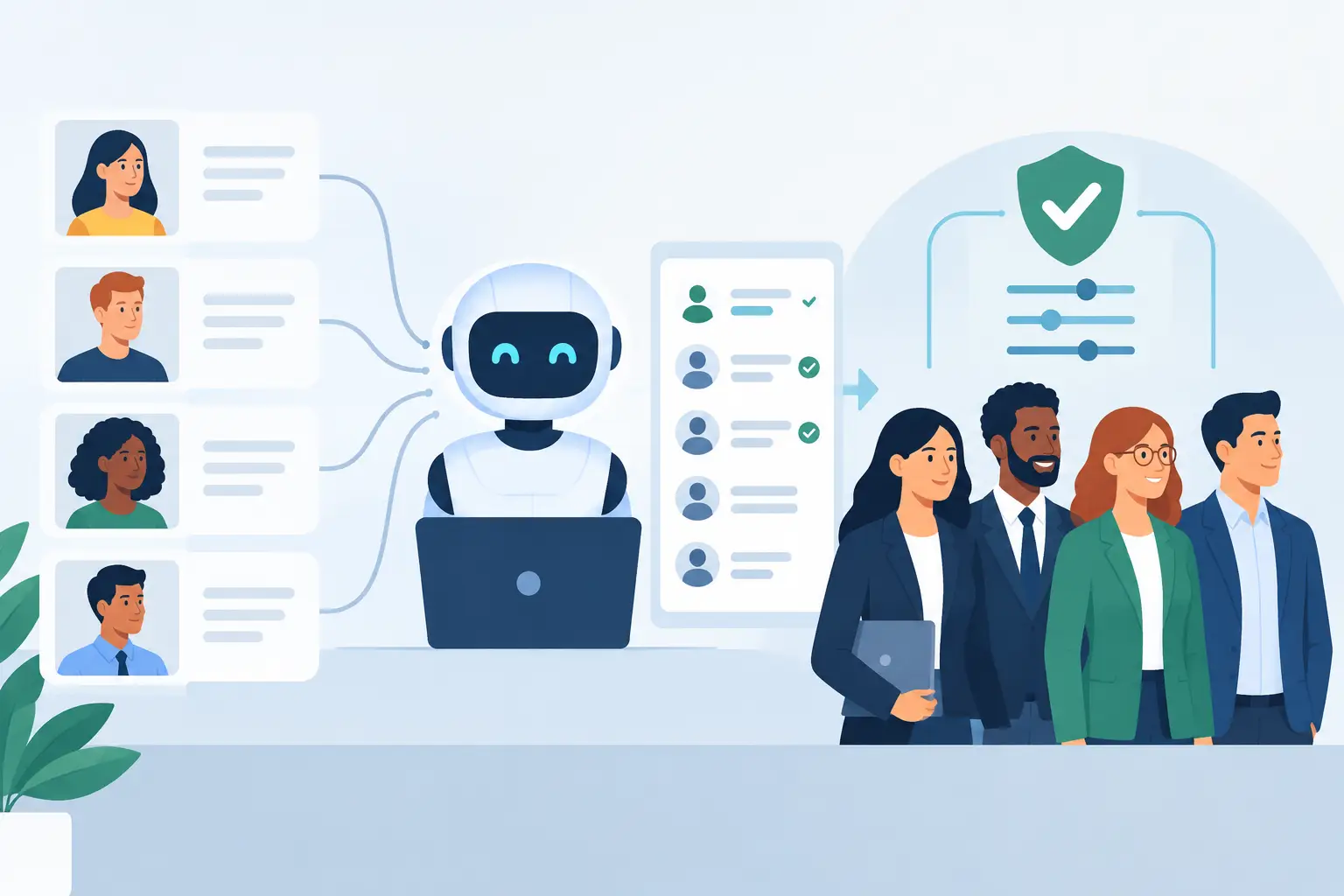
Bias typically enters the resume screening process when experience, career gaps, school names, formatting, or familiar employers get weighted differently by each reviewer. So the question isn’t whether AI can reduce hiring bias. It’s whether the AI you’re using is actually built to do so.
AI can reduce bias when it applies the same job-relevant standards to every candidate, shows the evidence behind each assessment, and leaves hiring decisions with people. Used carelessly, it can simply scale the preferences, blind spots, and bad data already present in the process.
The real question is not whether AI is biased or unbiased, it’s whether your screening system makes judgment more consistent, more visible, and easier to challenge.
Does AI Reduce Hiring Bias in Resume Screening?
It depends on what the AI is asked to evaluate and how recruiters use the result.
A first-pass screening tool can create a more consistent starting point. Instead of each recruiter deciding independently what “strong experience” looks like, the team defines the standard before reviewing applicants. For a sales operations role, that might mean experience with forecast management, CRM administration, process improvement, and cross-functional reporting. For a clinical operations role, it may mean regulated workflow experience, team leadership, and relevant systems knowledge.
Every resume should then be assessed against those same requirements. Not against gut feelings, a familiar company name and definitely not against whether a candidate used the preferred buzzwords.
That consistency matters because traditional resume review tends to be uneven. Recruiters are always working quickly and hiring managers may change their priorities halfway through a search. One may reward a nonlinear career path while another treats it as a risk. AI can help teams apply an agreed standard at scale, especially when applicant volume makes careful manual review difficult, but context matters.
But consistency is not the same as fairness. If the criteria are poorly chosen, the system will consistently evaluate candidates against the wrong standard. If a team treats an AI score as a final answer, it will turn a useful signal into an unexamined gatekeeper.
Where AI Can Make Bias Worse
AI inherits context, which includes the criteria you set, the data it uses, the information you allow it to consider, and the actions people take after receiving a result.
A system trained or configured around past hiring patterns will likely repeat those patterns. If previous decisions favored candidates from a narrow set of schools, employers, or career paths, historical outcomes can encode preferences that have little to do with performance in the role. A tool that rewards keyword overlap can miss qualified people who describe equivalent work differently.
Proxy signals are another risk. Details that appear neutral can stand in for factors unrelated to a candidate’s ability to do the job. Location, graduation dates, names, organizations, and career chronology can influence judgment in ways that are hard to see when reviewers are moving fast.
Then there is automation bias. People tend to give machine-generated recommendations more authority than they deserve, particularly when a system uses precise scores or polished language. A ranking can look objective even when the underlying criteria are subjective, incomplete, or stale.
The answer is not to avoid AI. The answer is to design controls that keep AI in its proper role: decision support, not decision replacement.
Start With Defined, Job-Relevant Standards
Bias reduction begins before the first resume is uploaded. A hiring team needs to agree on what evidence actually predicts success in the role.
That means separating must-have qualifications from preferences. A required certification, direct experience managing a regulated process, or demonstrated ability to lead a distributed team may be essential. A particular employer brand, a perfect career timeline, or phrasing that mirrors your own may not be.
Written criteria force a useful conversation. What does “senior” mean here? How much experience is enough? Is adjacent industry experience acceptable? Can a candidate demonstrate the skill through outcomes rather than a specific title? If the team cannot answer those questions before screening starts, each reviewer will have a different view during the process.
AI can make this discipline operational. JAN, for example, evaluates applicants against employer-defined criteria and returns A through D rankings with the supporting resume evidence. It reads for context, not just keywords, so a candidate whose experience is described in unfamiliar language doesn’t get filtered out for that alone.
A score without an explanation invites blind trust. A score with evidence gives recruiters something they can test.
Use Blind Screening Carefully
Blind screening can reduce the influence of information that is not relevant to the job. Removing or withholding selected identifying details during an initial review helps direct attention toward skills, accomplishments, scope, and demonstrated experience.
It is useful, but it is not magic. Resumes can still contain indirect signals about identity or background. More importantly, blinding does not fix a weak job definition. If your criteria favor a narrow career path without a business reason, removing names will not solve the underlying problem.
The strongest approach combines blind review with clear criteria and evidence-based assessment. Your team should be able to answer a simple question for every screening outcome: What in this candidate’s work history supports this assessment?
When an explanation cannot point to job-relevant evidence, it is a sign to revisit the score, the criteria, or both.
Keep Humans Accountable for the Decision
Recruiters and hiring managers bring context that resumes cannot fully capture. They can recognize transferable experience, ask whether an unconventional career path reflects resilience or relevant capability, and weigh needs that changed after the search opened.
That is why the best AI screening workflows preserve human authority at every meaningful decision point. AI can organize the applicant pool, identify evidence, surface gaps, and help prepare interviews. People decide whom to advance, whom to interview, and whom to hire.
Human review should not mean casually overriding the system whenever a familiar name appears. It should mean reviewing the evidence, documenting exceptions, and applying the same standard when similar cases arise. If a recruiter advances a lower-ranked candidate because of a compelling adjacent experience, that may be exactly the right call. The important part is that the rationale is visible and repeatable.
Targeted interview questions add another layer of accountability. When a resume claims ownership of a major initiative, the interview should validate scope, outcomes, decision-making, and the candidate’s specific contribution. AI can generate focused questions from the qualifications and gaps identified in screening, but the interviewer still tests the claim.
Audit the Workflow, Not Just the Tool
Teams often ask whether an AI system is accurate. That matters, but they should also ask whether their process is producing consistent outcomes.
Review how criteria are being used across recruiters and roles. Check whether certain requirements are routinely overridden. Look for rating patterns that suggest a criterion is too vague, too restrictive, or disconnected from job performance. Compare screened results with interview findings and eventual performance signals where appropriate.
This is operational quality control. It helps teams improve the screening standard instead of treating it as fixed forever.
Documentation is equally valuable. A defensible process records the criteria used, the evidence considered, the reasons for reviewer overrides, and the questions asked in interviews. That record supports better calibration across recruiters and helps leaders spot where judgment varies unnecessarily.
Privacy controls belong in the workflow as well. Candidate information should be handled with clear access controls, encryption, defined retention practices, and limits on how data is used. Trust is not a feature added after screening. It is part of the system candidates and hiring teams are being asked to rely on.
A Better Test for Hiring AI
Do not judge hiring AI by whether it promises to remove bias. No serious tool can make that promise.
Judge it by more practical questions. Does it require job-relevant criteria? Does it block protected-class criteria from the evaluation? Can recruiters see the evidence behind each ranking? Can they challenge or override the result? Does it help the team apply standards consistently while preserving human decision ownership?
If the answer is yes, AI can reduce some of the inconsistency that creates hiring bias. If the answer is no, it may only make a flawed process faster.
The goal is not to hand judgment to a bot. It’s to give recruiters a clearer standard, better evidence, and more time to make the decisions that require human judgment.